Discovery of Pathogenic Signaling Cascade in Capillary Malformations
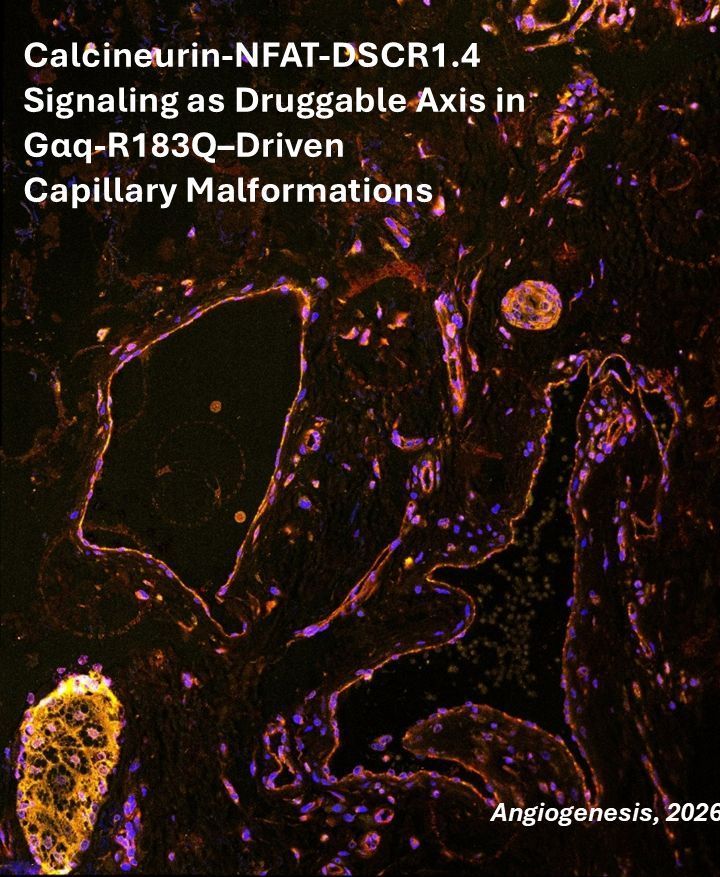
New publication ! The Huveneers lab identified the Calcineurin-NFAT-DSCR1.4 signaling pathway as a druggable driver of capillary malformations caused by the GNAQ p.R183Q mutation, which is associated with port-wine stains and Sturge-Weber syndrome.
Our research shows:
• How the Gαq-R183Q mutation in endothelial cells disrupts normal signaling, impairing cell migration and angiogenic sprouting
• That DSCR1.4 is a key mediator of these effects
• That inhibition of Calcineurin with Tacrolimus or depletion of DSCR1.4 can restore normal endothelial function
🔗 To learn more about our findings, please visit: https://link.springer.com/article/10.1007/s10456-026-10029-9
The article also includes a full phosphoproteomic dataset, provided as open-source data, mapping downstream signaling of the GNAQ p.R183Q mutation in endothelial cells.
With Tong Xu, Vera Janssen and Nathalie Reinhard as shared first authors, we would like to thank everyone who contributed!
Share this message
Latest news Medical Biochemistry Amsterdam